



2026 UKZN Spring Graduation

Research Investigates Silicon-Use Efficiency in Bread
Dr Marylyn Christian’s PhD in Plant Breeding, through the University of KwaZulu-Natal’s (UKZN) renowned African Centre for Crop Improvement (ACCI), sought to improve bread wheat quality and drought tolerance by using silicon fertilisers as a selection and breeding trait – a complicated exercise given the inverse correlation of these traits – which opened up new avenues for plant breeding.

Christian of Pietermaritzburg found tremendous value in the support, mentorship, and guidance from UKZN’s staff, taking on the challenge of pursuing a PhD in Plant Breeding after completing her honours and master’s degrees in Plant Pathology.
“The type of research that the ACCI does impacts food security in Africa and globally, producing ground-breaking and highly cited research that showcases the brilliance that Africa, and particularly South Africa, holds in terms of agricultural research,” said Christian.
Titled: ‘Pre-breeding for Silicon-Use Efficiency to Enhance Drought Tolerance and Grain Protein Content in Bread Wheat (Triticum aestivum L.)’, Christian’s research targeted the novel area of silicon-use efficiency, aiming to improve bread wheat yield, quality and drought tolerance, challenging traits that are often inversely correlated. Silicon fertilisers can improve crop performance and nutrient quality, particularly under stress. Genetic crosses based on complementary backgrounds and selection for silicon-use efficiency offer new opportunities for wheat breeding.
Producing five scientific articles in international journals, Christian’s research showed that silicon-use efficiency is breed- and application-dependent, with controlled silicon fertilisation improving agronomic performance, grain protein content and trait associations, while supporting breeding for enhanced yield and drought tolerance.
Navigating a challenging topic as well as a pause in her studies to care for her elderly parents and run the family business was demanding but Christian found that the perseverance, passion and patience required by Plant Breeding helped her realign and adjust to difficult circumstances.
Christian thanked her supervisors, Professor Hussein Shimelis, Professor Mark Laing, and Professor Toi Tsilo for their support and motivation, and the ACCI, Agricultural Research Council, Institute for Commercial Forestry Research, the Rockefeller Foundation and the National Research Foundation for funding her research. She also thanked her family, friends and colleagues for their support and assistance.
Christian has set her sights on a career in research, either in academia or agricultural entrepreneurship, and plans to pursue a postdoctoral fellowship at UKZN.
Words: Christine Cuénod
Photograph: Sethu Dlamini
Research Advances Genetic Improvement of Important Cereal Crop
Senior Agricultural Scientist and Plant Breeder at the Ethiopian Institute of Agricultural Research (EIAR), Dr Adane Gebreyohannes Woldetensay, was awarded his PhD through the African Centre for Crop Improvement (ACCI) at the University of KwaZulu-Natal (UKZN).
Woldetensay’s research focused on the genetic improvement of finger millet, an underutilised, nutritious and climate-resilient crop indigenous to Africa.
His thesis: ‘Breeding of Finger Millet for Agronomic and Nutritional Traits and Drought Tolerance in Ethiopia’, combined multi-environment phenotyping, quantitative genetics, hybrid evaluation and genome-wide association mapping to identify genetic resources for improved finger millet. He identified genotypes demonstrating improved agronomic performance, early maturity, high iron and zinc content, and drought tolerance.
Said Woldetensay. “My interest in plant breeding is rooted in a practical question: How can genetic diversity be systematically converted into improved crop varieties that perform reliably under the increasingly variable conditions faced by farmers?”
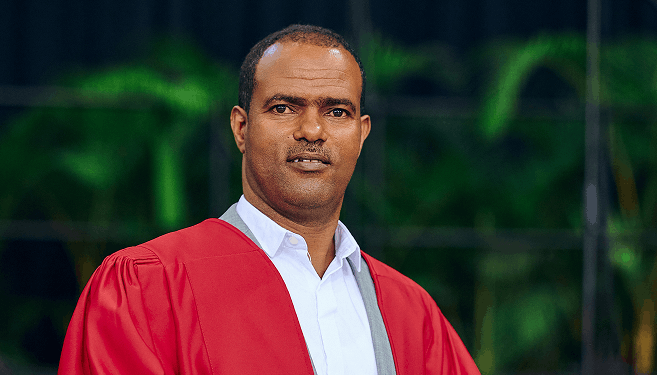
Originally from Ethiopia, Woldetensay completed undergraduate and master’s degrees in Applied Genetics at Addis Ababa University before building a 15-year career in sorghum and millet improvement at EIAR. He chose UKZN for its strengths in Plant Breeding, Genetics, and Agricultural Science, and its international research linkages, valuing the opportunity to integrate quantitative genetics, genomics, stress biology, and multi-environment testing.
With genetic improvement in finger millet less advanced than in major cereal varieties, the crop has significant potential for dryland farming systems. Woldetensay’s research revealed substantial genetic variation in drought tolerance that can be harnessed through targeted breeding. It also showed that varieties performing well under favourable conditions are not necessarily the most productive or stable under drought, highlighting the importance of testing breeding materials across representative environments.
Genetic analyses further demonstrated that the relative influence of additive and non-additive genetic effects varies among traits and environments, informing breeding strategies ranging from recurrent selection to hybrid breeding. Overall, the research reinforces the idea that climate resilience is a complex outcome shaped by interactions among genotype, environment and their interactions.
Woldetensay overcame COVID-19 disruptions, data delays, political instability and insecurity in parts of Ethiopia while balancing his professional responsibilities. He published five peer-reviewed papers (including a top-cited Wiley article), a book chapter and other research outputs during his PhD.
His research was funded through the International Crops Research Institute for the Semiarid Tropics (ICRISAT) and the International Maize and Wheat Improvement Centre (CIMMYT).
His professional contributions include serving as CIMMYT Regional Trait Champion for Finger Millet Blast in Eastern and Southern Africa and Chief Scientific Investigator of a joint Food and Agriculture Organization/International Atomic Energy Agency research project on accelerating finger millet improvement. Woldetensay will continue working at the intersection of genetics, genomics, stress phenotyping and demand-led crop improvement, with a focus on developing productive, resilient and nutritionally valuable dryland cereals.
“My PhD marks the beginning of a new chapter in my scientific journey; it has strengthened my capacity to integrate genetics, genomics and plant breeding to address some of Africa’s most pressing agricultural challenges.”
Woldetensay thanked God; his PhD supervisor, Professor Hussein Shimelis; the ACCI team, and colleagues and collaborators, particularly Professor Mark Laing, Dr Damaris Odeny, Dr Jacob Mashilo, Dr Taye Tadesse, and Dr Chris Ojieo, for their mentorship and technical and research support.
He acknowledged ICRISAT, CIMMYT, EIAR, the Gates Foundation, the Melkassa Agricultural Research Centre, the National Sorghum and Millets Research Program, the Ethiopian Biodiversity Institute and the National Meteorology Agency for their support.
He thanked his parents, wife, and son for their love, patience, and sacrifices.
Words: Christine Cuénod
Photograph: Sethu Dlamini
